Ultrasonic Commercial Dishwashers: How Cavitation Cleans What Spray Arms Miss
How an ultrasonic commercial dishwasher uses cavitation to remove baked-on soil that spray arms cannot reach — standalone tanks vs integrated pre-wash, explaine...
Every busy kitchen knows the problem: pans with carbonized sauce, trays glazed with baked-on sugar, roasting sheets that a pressure jet just smears around. Spray arms clean loose soil well, but stuck-on residue needs a different physics. That is where an ultrasonic commercial dishwasher changes the equation — and why ultrasonic pre-wash has become the feature buyers ask about first.
How an ultrasonic commercial dishwasher works
Ultrasonic cleaning uses cavitation. Transducers mounted in the wash tank vibrate at ultrasonic frequency, creating millions of microscopic bubbles in the water. When those bubbles collapse against a surface, they release concentrated micro-jets that lift soil particle by particle.
The key advantage is contact. Spray arms only clean what the jet can reach — shadowed corners, pan rims, tray edges, and engraved surfaces stay dirty. Cavitation bubbles reach every wetted surface at once, so the cleaning action is genuinely 360 degrees, in gaps and crevices included. And because the bubbles do the work, the process is gentle: no abrasive scrubbing, no damaged non-stick coatings, no bent aluminum sheet pans.
Two ways Oberon puts ultrasonics into a dishroom
1. A standalone ultrasonic cleaning tank
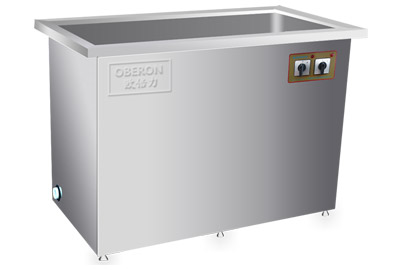
The Oberon ST Series is an automated ultrasonic cleaning tank built for decarbonizing and degreasing kitchen equipment — pans, roasting trays, hood filters, baking molds, and smallwares. With a capacity of 1,500 to 4,500 plates per hour equivalent and just 2–3 kW of power, it soaks off carbon that would otherwise take hours of hand scraping. Load it, close the lid, and the cycle runs unattended while staff do other work.
2. An integrated ultrasonic pre-wash
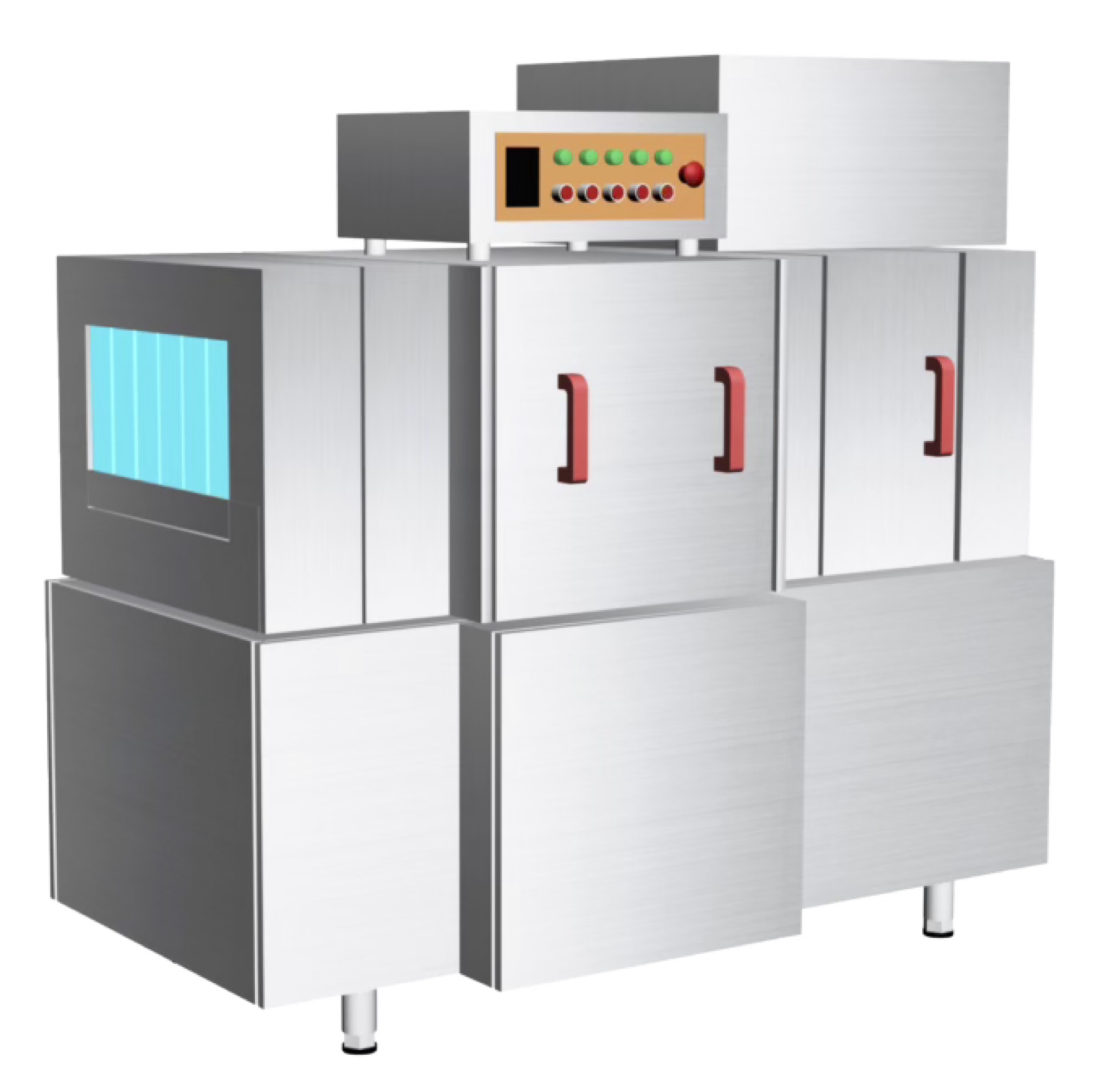
For kitchens that want the benefit inside the main line, the Oberon SonicFlow is a hood-type dishwasher with an ultrasonic pre-wash tank built in. Dishes pass through cavitation before the main wash, arriving at the spray section with soil already lifted. The result is 70 racks per hour at just 2.2 liters of water per rack — deep cleaning without a separate soaking station.
Where ultrasonic dishwashing pays off fastest
- Bakeries and pastry shops: caramelized sugar and dough films that survive spray jets release in an ultrasonic tank, and non-stick tray coatings stay intact.
- Central kitchens: GN pans and cookware with baked-on residue stop blocking the main dishwasher line.
- Hotels and banqueting: equipment decarbonizing that used to happen overnight with caustic soak happens in a supervised cycle.
- Any kitchen fighting rewash queues: pre-wash cavitation means items do not come back a second time.
What ultrasonic does not replace
An ultrasonic stage lifts soil; it does not sanitize. A commercial dishwasher still needs its hot final rinse or chemical sanitizing step after the ultrasonic wash, and heavily greased loads still benefit from pre-scraping. Think of ultrasonics as the deep-cleaning stage that makes every other stage faster and cheaper — not a standalone replacement for the dish line.
What to check before buying
- Tank size vs your worst item: the item must fit fully submerged, with clearance for cavitation to reach all faces.
- Automation: automated lift, filtration, and cycle control decide whether the tank saves labor or just adds a tub to watch.
- Power and utilities: ultrasonic transducers are efficient — the ST Series runs on 2–3 kW — but confirm heating power and water treatment separately.
- Construction: full stainless tank, welded transducer mounting, and accessible service points, same as any commercial dishwasher.
Frequently asked questions
Does ultrasonic cleaning damage non-stick coatings or delicate items?
No. Cavitation is gentler than scrubbing or high-pressure jets, which is why it is used on non-stick baking sheets, decorated wares, and precision kitchen equipment.
How fast is an ultrasonic commercial dishwasher?
The Oberon ST Series ultrasonic tank handles 1,500–4,500 plates per hour equivalent in unattended cycles, and the SonicFlow hood type machine with built-in ultrasonic pre-wash runs 70 racks per hour through the full line.
Can I add ultrasonic pre-wash to my existing dishwasher?
An integrated pre-wash requires the machine to be engineered for it, like the SonicFlow. As a retrofit, a standalone ultrasonic tank placed ahead of the existing dishwasher achieves the same deep-clean result.
Does ultrasonic cleaning use a lot of water and power?
No. The transducers themselves draw little power (2–3 kW on the ST Series), and because the tank water does the cleaning, water consumption stays low compared with repeated rewash cycles.
Related reading
- Commercial dishwasher cost guide
- Bakery tray washing solutions
- Commercial dishwasher maintenance checklist
Want to see whether ultrasonics fit your dishroom? Tell Oberon your item mix and peak volumes — we will recommend the right ultrasonic configuration, from a standalone ST tank to a fully integrated SonicFlow line.